


Load balancing makes the EV charger (wallbox) and the rest of the house share the current that the main fuse lets through. If the cooker, the heat pump and the water heater are all running at once, the charger lowers its power. When the house quietens down, charging goes back up. The main fuse is the fuse closest to the electricity meter, and it sets the limit for how much electricity the whole house can use at one time.
How load balancing works
Load balancing consists of a measuring unit at the electricity meter that tells the charger how heavily the house is loaded. The Swedish National Electrical Safety Board, Elsäkerhetsverket, describes it on its page about planning a charge point: the equipment measures the load on the property, and the charge point limits the power going to charging if necessary.
In practice it happens in three steps, over and over again:
- The measuring unit reads how much current the house is drawing on each phase. A phase is one of the three live conductors that come into a house with a three-phase supply.
- The charger works out how much is left up to the limit of the main fuse.
- The charger adjusts the current to the car, up or down.
All you notice is that charging is slower during the hours when the house is using a lot. The car is still charging. Without load balancing the main fuse could have tripped, and then the whole house loses power.
Why the main fuse is not always enough
An 11 kW charger draws 16 A on each of the three phases, as much as an entire 16 A main fuse lets through. E.ON writes on its page about installing an EV charger that anyone with a 20 A meter fuse has very little power left for anything else while the car is charging. Meter fuse (mätarsäkring) is E.ON’s word for the main fuse.
| Charging | Current | Power |
|---|---|---|
| Single-phase 16 A | 16 A on one phase | about 3.7 kW |
| Three-phase 16 A | 16 A on three phases | about 11 kW |
| Three-phase 32 A | 32 A on three phases | about 22 kW |
The power is the number of phases times 230 V times the current. This is what it looks like when an 11 kW charger is charging at full power:
- 16 A main fuse: the charger takes everything. Nothing is left for the house.
- 20 A main fuse: 4 A per phase is left, just under 1 kW on each phase. A kettle draws roughly twice that.
- 25 A main fuse: 9 A per phase is left, roughly 2 kW on each phase.
According to Kraftringen, a main fuse of 16 to 25 A is enough for most homes. That applies to the household without an electric car. With a charger on the same fuse, something has to keep track of who gets the current.
When load balancing is needed and when it is not
As a rule you need load balancing when the charger alone can take most of the main fuse. That is usually the case if
- the main fuse is 16 or 20 A and the charger is 11 kW
- the house is heated with direct electric heating or a heat pump
- you have a hot tub, a sauna or other large loads
- two chargers are to share the same main fuse.
You can often manage without it if the main fuse is large in relation to the house, or if the charger is set to a lower fixed current. Elsäkerhetsverket points out that high charging power is often unnecessary: if the car can stay plugged in all night, a lower power is enough for the daily driving of most households.
A charger that is always throttled does, however, charge slowly even when the house is not using any electricity at all. Load balancing puts that headroom to use, and that is the difference between the two solutions.
If the main fuse already trips today, without an electric car, the fuse is probably too small for the house. In that case load balancing only solves part of the problem. Common causes and what you can check yourself are in the article on when the fuse keeps tripping.
Load balancing or a larger main fuse
Load balancing is usually the cheaper first step, because a larger main fuse means a higher fixed fee every year. Kraftringen puts it like this: the larger the fuse, the higher the fee.
| Question | Load balancing | Larger main fuse |
|---|---|---|
| What you get | Charging adapts to the house | More current for the whole house |
| Price in our list | SEK 928 for Zaptec Sense | SEK 686 for a change within 16–25 A, notification included |
| Running cost | No change | Higher fixed grid fee |
| Notification to the grid operator (elnätsföretag), the company that owns the local grid | The same as for the charger, and that depends on the grid operator | Yes |
If the fuse is to be raised above 25 A, it becomes a bigger job. The step from 25 to 35 A in a wall-mounted or free-standing meter cabinet from Garo is in our price list at SEK 4,250, with pre-notification and completion notice (för- och färdiganmälan, the notices to the grid operator before the work starts and when it is finished), provided that the service cable, that is, the cable from the grid to the meter cabinet, can already carry the higher current. The grid operator’s own fees come on top of that. E.ON, for example, states that it does not charge for raising the fuse up to 25 A but that the running grid fee changes, and that raising it above 25 A leads to a quote for a connection fee.
The two solutions do not rule each other out. A house with electric heating, a hot tub and two electric cars may need both a larger fuse and load balancing.
Load balancing does not lower the grid fee
Load balancing does not give you a lower grid fee today. The argument that you have to cut power peaks to avoid a capacity charge (effektavgift) does not apply to households with E.ON, Kraftringen or Öresundskraft. There, households pay according to the size of the fuse and how much electricity is transferred.
The requirement that all grid operators should introduce capacity charges was removed in 2026. The Swedish Energy Markets Inspectorate, Energimarknadsinspektionen, repealed the regulations in June 2026 and is to submit a new proposal to the government by 12 April 2027 at the latest, according to the authority’s page about the assignment. So the rules may change again. Do not buy load balancing to lower a fee that does not exist. Buy it so that the fuse holds.
What load balancing costs
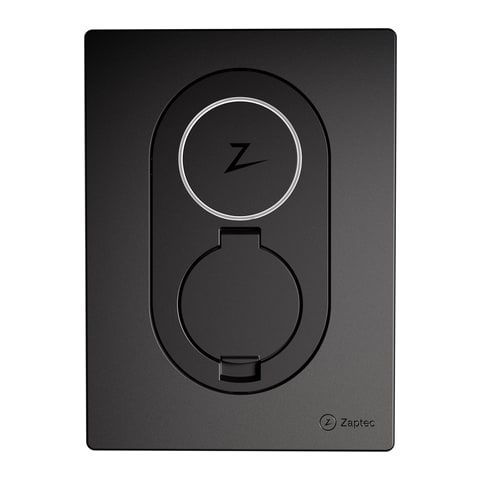
For the Zaptec Go charger, the load balancing unit is called Zaptec Sense. There are three lines in our price list:
- Zaptec Sense for electricity meters with a P1 port (RJ12): SEK 928
- Zaptec Sense for electricity meters with a HAN port (RJ45): SEK 948
- adapter with power supply for the Kamstrup Omnipower meter: SEK 1,267.
Which one fits depends on which electricity meter the grid operator has installed at your home. The prices apply to a standard installation and include materials, installation and 25 per cent VAT. A travel charge of SEK 500 is added.
An 11 kW Zaptec Go costs SEK 11,096 installed. Charger and Sense together come to SEK 12,024 before the tax reduction and the travel charge. The price list also gives a price after the Swedish tax reduction for green technology (grön teknik), for those who are entitled to it. The conditions are in the article on the green technology reduction for EV chargers.
When to get in touch
If you are getting a charger and have a main fuse of 16 or 20 A, it makes sense to plan for load balancing from the start. Send us a photo of the consumer unit and the meter cabinet (the cabinet that holds the electricity meter and the main fuses), and tell us what heats the house. How the installation is done is described on the page about EV chargers, and all the amounts are in the price list for EV chargers. If the fuse has to be raised anyway, we describe the procedure in the article on raising the main fuse.