When cable is better than wifi
Cable is better for everything that stays put and has to work every time. A network cable is not affected by walls, floors or the neighbours’ networks. Wifi is. Concrete and brick dampen the signal more than a light internal wall, and every storey takes its share.
These are usually worth a cable of their own:
- the computer and the printer in the study
- the TV, the media player and the games console
- the wifi access points, so that they do not have to talk to each other wirelessly
- equipment in the garage, in the basement or on a different floor from the router.
Phones and tablets run on wifi, of course. But good wifi starts with cable too, because a wifi access point can only pass on the connection it gets itself.
Network sockets in the wall
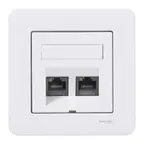
A flush-mounted network socket costs SEK 1,905 installed, or SEK 1,626 with the Swedish ROT tax deduction for labour on your home (ROT-avdrag). Materials, installation and VAT are included. The sockets are of the Exxact/Actassi type. Exxact is the same brand as several of the power sockets and switches in our price list.
A single and a double socket cost the same. Choose the double if you are in the slightest doubt. Around the TV you quickly end up with a TV, a media player and a games console.
Every socket gets its own cable back to the place where the network equipment stands. That is why the place for the equipment is decided first and the sockets after that.
The price applies to a standard installation: a normally accessible place where there is a route for the cable. If the cable has to take a detour through several floors, or the wall has to be opened, that counts as extra work. In that case we give you a quote before we start.
Wifi access point with a cable run to it
A wifi access point costs SEK 5,815, or SEK 4,955 with ROT. It is a Ubiquiti UniFi U6+, and the price includes the access point, the cabling and the commissioning.
A wifi access point, or just access point, is a transmitter that sits on the ceiling or the wall and is connected to the router by cable. The difference from a wireless repeater is precisely the cable. The repeater receives a signal that is already weakened and passes it on. The access point gets a full connection through the cable and transmits from there.
Placement matters more than the number. A wifi access point should sit in the open and close to the rooms where the network is used, not in a cupboard or behind the TV. How many are needed depends on the storeys, the floor plan and the wall material.
How to plan the network in a house
A network that is run in the walls should last a long time, so the planning pays off. Go through this in order:
- Where does the broadband come in? The fibre termination box or the broadband socket is the starting point for everything else.
- Where will the equipment stand? The router and the network switch need a place with power, air and reasonable access. A media enclosure, a cabinet where the equipment is gathered, is in the price list for SEK 5,808, or SEK 5,034 with ROT.
- Which rooms need sockets? Count the study, the living room and rooms that may become a study later.
- Where should the wifi access points sit? Mark them on a floor plan, one storey at a time.
- Is there power where the equipment ends up? A new power socket is electrical installation work. A new flush-mounted double socket costs SEK 1,720 with up to 7 metres of cable.
- Are the walls open anyway? Then this is the right moment. See the pages about electrics when renovating and electrics in new builds.
Much else in the house also wants a network connection where it sits, for example the controls in a smart home. Include that in the planning.
What you may do yourself and what is electrical work
You may run network cable and put up data sockets yourself. The requirement in the Swedish Electrical Safety Act (elsäkerhetslagen) to use an electrical installation company (elinstallationsföretag) applies to power installations (starkström), and a network is low-current (svagström). The Swedish National Electrical Safety Board, Elsäkerhetsverket, says it straight out in its service Koppla säkert (“connect safely”): you may install a data socket.
| Work | May you do it yourself? |
|---|---|
| Run network cable and fit data sockets | Yes |
| Replace an existing data socket | Yes |
| Connect a router or network switch with a plug | Yes |
| Put up a new power socket by the equipment | No, an electrical installation company has to do that |
| Work in the consumer unit | No |
That it is permitted does not mean it is easy. The hard part is seldom the socket itself. It is getting the cable there out of sight, through walls and floors, without damaging anything on the way.
Network cables and power cables often end up close together. From an electrical safety point of view that is no problem when the power cables are double-insulated, writes SEK Svensk Elstandard. Interference is another matter. For that there is the standard SS-EN 50174-2, which sets requirements for the distance between data and power cables, and SS-EN 50174-3 for cable laid outdoors.
The reason to use us is usually that the electrics and the network are done in the same job. We are an electrical installation company that also runs data cabling. The power socket for the cabinet, the cable to the wifi access point and the socket by the desk become one visit instead of two.
Networks in offices, shops and other premises
In business premises the network is part of the day-to-day running, and it is usually installed at the same time as the electrics are rebuilt. We work for businesses and building projects, and our registration with Elsäkerhetsverket covers general and public spaces such as offices, shops, restaurants and schools.
A quote for premises is based on:
- the number of workstations and how many sockets each one is to have
- the number of wifi access points and where they are to sit
- where cabinets and equipment are to stand, and whether there is power there
- how the cable can be run: above a suspended ceiling, in trunking or in the wall.
If you rent the premises, it is wise to talk to the landlord first. Elsäkerhetsverket writes that in rented premises the property owner is normally the holder of the installation (innehavare), the owner or user who is responsible for it, and that the division of responsibility should be set out in the lease. There is more about how we work with premises on the page for businesses and properties.
Price, deduction and quote
Three items have a fixed price: network socket, wifi access point and media enclosure. The price includes materials, installation and 25 per cent VAT. A travel charge of SEK 500 is added. The network socket and the wifi access point are in the price list for networks and wifi, and the media enclosure is listed among the fixed prices for consumer units.
The price list also shows a price with ROT. It applies if you are entitled to the deduction, and the conditions can vary. ROT is only given on the labour cost. Businesses and tenants cannot get ROT.
For a whole house or whole premises we give a quote. What decides the price is the number of sockets and wifi access points, how long the cable routes are and how easy it is to get through. Contact us with a floor plan and a list of where you want sockets. We are based in Malmö and work in the rest of Skåne.
Sources
- Elsäkerhetsverket – What applies to low-current installations (in Swedish)
- Elsäkerhetsverket, Koppla säkert – Installing a data socket (in Swedish)
- Elsäkerhetsverket – What counts as electrical installation work (in Swedish)
- SEK Svensk Elstandard – Questions and answers (in Swedish)
- Elsäkerhetsverket – The register search Kolla elföretaget (in Swedish)