What the electrics for a new house include
The electrical installation in a new house is everything from the connection to the grid to the last socket. It is done in stages that follow the build, and the first one begins before there is any house.
- Site power (byggström). Temporary electricity for the build.
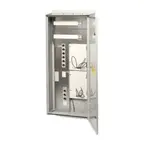
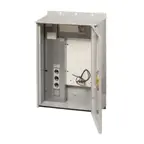
- Meter cabinet and main supply cable. The cabinet that holds the electricity meter, and the cable from there into the house.
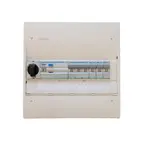
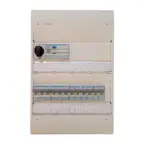
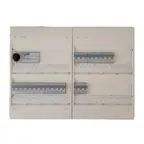
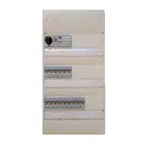
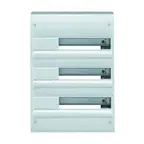
- Consumer unit. Fuses, residual current devices (RCDs) and the division into circuits. A circuit is the sockets and lights that share one fuse.
- Conduit, boxes and cable in walls, floors and ceilings.
- Sockets, switches and lighting outlets (the plug-in outlets for light fittings).
- Permanently connected appliances, such as the cooker, water heater and fans.
- Options, such as underfloor heating, EV charger (wallbox), network and controls.
Only registered electrical installation companies (elinstallationsföretag) may do the electrical installations, according to the Swedish National Electrical Safety Board, Elsäkerhetsverket, on its page about the regulations for newly built homes. For a residential building the registration must cover the activity type “Bostäder” (dwellings). LVJ-EL is registered with Elsäkerhetsverket for, among other things, dwellings and for general and public spaces such as offices, shops, restaurants and schools. How to check that yourself is described in the guide to Elsäkerhetsverket’s register search Kolla elföretaget (“check the electrical company”).
Site power and temporary connection
Site power is electricity that the build uses before the house has an installation of its own. The grid operators (elnätsföretag), the companies that own the local grids, not the ones you buy electricity from, call it a temporary connection. It is ordered by an electrical installation company filing a pre-notification (föranmälan), a notice sent to the grid operator before the work starts.
Kraftringen describes the process like this:
- You engage an electrical installation company, which files a pre-notification in good time before the connection date you want.
- You and the electrical installation company arrange the site power cabinet, the service cable and the conduit. The service cable is the cable from the grid to the cabinet.
- The electrical installation company files the completion notice (färdiganmälan) no later than 14 days before the day the power is to be connected.
Other grid operators have their own routines and lead times. In Malmö it is E.ON that owns the grid.
Our price list has two items that concern the temporary power:
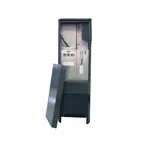
- Free-standing meter cabinet with sockets for temporary power. A 25 A Garo cabinet costs SEK 23,908. It comes with a ground stand, a 16 A CEE socket, an ordinary socket, an RCD for the temporary power, pre-notification and completion notice (för- och färdiganmälan) and up to 10 metres of underground duct. The 63 A cabinet costs SEK 26,676.
- Temporary installation at a meter position in a block of flats. Pre-notification and completion notice for 16 to 63 A, fitting of gauge pieces and inspection cost SEK 666. A gauge piece is the insert that decides how large a fuse will fit.
Elsäkerhetsverket points out that there are special requirements for electrical installations on building sites. Cables must be protected against damage from site vehicles and machinery. It is also sometimes unclear who is responsible for the temporary power when several companies work on the same site. Settle that from the start. There is more in the guide to site power.
Meter cabinet and connection to the grid
The new house’s connection to the grid must be pre-notified, and the meter cabinet is the first permanent part of the installation. There are two routes:
| Solution | What is included | Price |
|---|---|---|
| Free-standing meter cabinet, 25 A, on a ground stand | Sockets and RCD for temporary power, pre-notification and completion notice, up to 10 metres of underground duct | SEK 23,908 |
| Flush wall-mounted meter cabinet, 25 A | Pre-notification and completion notice, up to 10 metres of underground duct | SEK 11,194 |
| Flush wall-mounted meter cabinet, 63 A | The same installation as the 25 A cabinet | SEK 14,919 |
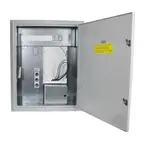
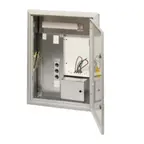
A flush wall-mounted meter cabinet, which is set into the outer wall, needs an opening of 71 × 54.2 cm in the wall. It has to go on the drawing before the frame is raised. The cable between the cabinet and the consumer unit costs SEK 236 per metre, laid in underground duct and rated for 32 A.
Three things fall outside these prices:
- Groundworks. You or your groundworks contractor arrange the trench. We lay the ducts and the cable, because that may only be done by an electrical installation company.
- The grid operator’s connection fee. You pay that to the grid operator.
- ROT. The price list shows a price with the Swedish ROT tax deduction for labour on your home (ROT-avdrag), but it does not apply to new builds.
Do not choose a larger main fuse than the house needs. The main fuse is the fuse that decides how much electricity the house can use at the same time. Kraftringen writes that 16 to 25 A is enough for most homes, and that the fixed charge gets higher the larger the fuse is. There is more about cabinets and fuses on the page about meter cabinets and main fuses.
The consumer unit also has a fixed price. A unit from Hager with one row and 13 modules costs SEK 5,810, and one with four rows and 52 modules costs SEK 13,794. The whole range is in the fixed prices for consumer units.
How the work is done, from frame to finished installation
The electrics follow the build, and every step has a point when it is easy to do and a point when it is too late.
- Planning on the drawing. Sockets, switches, lighting, consumer unit and meter cabinet are decided before the build starts.
- Site power. The temporary power is pre-notified and connected.
- Conduit and boxes. They are set in walls, floors and ceilings while the frame is open.
- Cable. The wires are drawn through the conduit once the house is weathertight.
- Meter cabinet and consumer unit. The cabinet is fitted, the cable is brought in and the unit is wired up.
- Fitting. Sockets, switches, light fittings and appliances are put up when the surfaces are finished.
- Inspection and documentation. The installation is inspected and tested before it is put into use, and it is labelled.
- Completion notice. The grid operator is told that the installation is ready to be connected.
The most expensive mistake is deciding late. A socket added on the drawing costs little. The same socket in a finished, painted wall costs considerably more.
Requirements for new electrics that are worth knowing
A new installation must follow today’s rules in full. Under Elsäkerhetsverket’s regulations it must be carried out in line with good electrical safety practice, and the usual way to meet that requirement is to follow the Swedish standard, that is, the Swedish wiring rules (Elinstallationsreglerna, SS 436 40 00).
- RCD. Today’s rules require an RCD as additional protection for practically all sockets, and it is a requirement for all newly built homes. An RCD cuts the power when current leaks to earth.
- Earthed sockets with shutters. All sockets must be earthed, and they must have child-safety shutters or be placed so that children cannot reach them.
- DCL outlets for ceiling lights. They are standard in new builds.
- Bathrooms. All circuits that supply the bathroom must have a 30 mA RCD, and a socket must sit at least 60 cm from the edge of the bath or 120 cm from the fixing point of the shower head.
- Inspection before use. A new installation must be inspected and tested before it is put into use.
- Labelling and documentation. The installation must have the labelling and documentation needed for operation and maintenance, and there must be an up-to-date circuit chart at the consumer unit.
The law does not require any particular certificate. If you want more documentation than the rules require, it has to be in the contract.
Plan for a charger, network and controls from the start
Whatever may come later should get its conduit now. An empty conduit in an open wall costs next to nothing compared with opening the wall again.
- EV charger. An 11 kW Zaptec Go costs SEK 11,096 installed, or SEK 5,548 with the Swedish tax reduction for green technology (grön teknik). The reduction can also be given for a house under construction. There is more on the page about EV chargers.
- Network. A flush-mounted network socket costs SEK 1,905. How sockets, wifi access points and cabinets are planned is described on the page about data and networks.
- Controls. Some systems for controlling lighting and sockets need wiring of their own. Decide on the system before the conduit is set. See the page about smart homes.
Price, quote and why ROT does not apply
The electrics in the house itself have no fixed price, because they depend on the drawings. What decides the price is the size of the house, the number of sockets, switches and lighting outlets, how much is to be done in the kitchen and bathroom and which options you want. We quote from the drawings.
The meter cabinet, the consumer unit and the notifications have fixed prices in which materials, installation and 25 per cent VAT are included. A travel charge of SEK 500 is added. The prices apply to standard installations.
The ROT deduction is never given for new builds. The Swedish Tax Agency, Skatteverket, writes that you cannot get a deduction for building a completely new home or another free-standing building. So count on the price without ROT.
Developers and contractors will find more on the page for building projects. Contact us with drawings and a rough timetable, and we will come back to you with a quote.
Sources
- Elsäkerhetsverket – Which regulations apply when a new home is built (in Swedish)
- Elsäkerhetsverket – Temporary electrical installations (in Swedish)
- Kraftringen – Temporary connection (in Swedish)
- Elsäkerhetsverket – Documentation and labelling (in Swedish)
- Elsäkerhetsverket – Who may lay cable in the ground (in Swedish)
- Elsäkerhetsverket – If the company is not in the register (in Swedish)
- Skatteverket – How the ROT deduction works (in Swedish)
- Skatteverket – Tax reduction for green technology (in Swedish)