
Electricity in the bathroom is governed by three things: where in the room something sits, how well it withstands water, and that everything is protected by a residual current device (RCD). The Swedish National Electrical Safety Board, Elsäkerhetsverket, sums up the principle in one sentence on its page about electricity in bathrooms and shower rooms: “The damper or wetter, the higher the moisture protection (IP rating).”
Elsäkerhetsverket’s own regulations have no detailed rules on bathrooms. The details are in the standard, the Swedish wiring rules (Elinstallationsreglerna, SS 436 40 00). The standard has to be paid for, so the measurements here come from what Elsäkerhetsverket and SEK Svensk Elstandard, the Swedish electrical standards body, have themselves published about it.
The bathroom is divided into zones
Bathrooms and shower rooms are divided into zones 0, 1 and 2. In everyday Swedish people often say zoner (zones), but the standard’s word is område (area). Zone 0 is the wettest, and the requirements fall the further you get from the bath or the shower.
| Zone | Lowest IP rating | What applies there |
|---|---|---|
| 0 | IPX7 | The wettest zone, with the highest requirements |
| 1 | IPX4, or IPX5 if the equipment is exposed to water jets | Electrical appliances must be permanently fixed, permanently connected and intended for zone 1 according to the manufacturer |
| 2 | IPX4, or IPX5 if the equipment is exposed to water jets | Electrical appliances must be permanently fixed and permanently connected. No mains-connected sockets |
| Outside the zones | Often IPX1, for example IP21 | This is where sockets are placed |
The bottom row is based on the whole bathroom usually being judged to be a damp location, according to SEK. According to the same source, zone 1 may contain, for example, whirlpool baths, shower pumps, ventilation equipment, heated towel rails, water heaters and light fittings, if they are made for it.
A new feature of the latest edition of the standard, from 2023, is that a shower screen can form the boundary of zones 0 and 1. How far the zones extend in height is shown in figures in the standard that we do not reproduce here. Let the electrician measure on site before you decide where anything is to go.
The distances for sockets
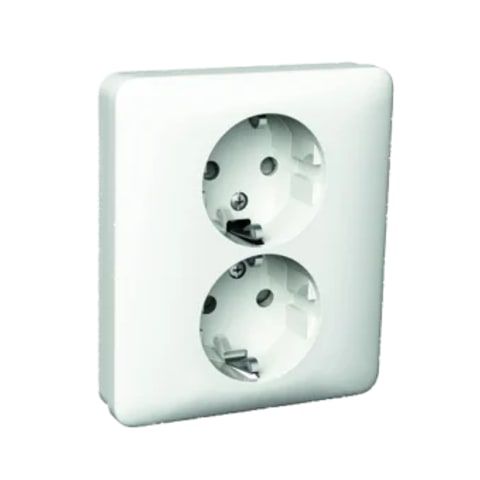
A socket must be outside zones 0, 1 and 2. SEK gives two measurements:
- at least 60 cm from the edge of the bath
- at least 120 cm from the shower head’s fixing point.
The measurement at the shower is therefore taken from the fixing point, not from the shower screen or the floor drain. Elsäkerhetsverket writes: “Sockets in bathrooms and shower rooms must be protected by an RCD and may not be placed just anywhere.” The authority also writes that sockets and appliances with plugs must not be in the dampest zone closest to the shower or the bath.
If the bathroom has no socket, the solution is never an extension lead. Elsäkerhetsverket explicitly advises against running in an extension lead from a socket in another room, for example for a hairdryer or a washing machine.
A room with only a toilet and a washbasin, without a shower or bath, does not normally count as a bathroom or shower room under the standard. In that case the division into zones does not normally apply either.
How to read the IP rating
The IP rating is on the product and in the instructions. The second digit shows the protection against water. When the first digit is replaced by an X, the protection against solid objects is not specified in the requirement.
| Second digit | Protection according to Elsäkerhetsverket |
|---|---|
| 4 | Protected against splashing water from all angles |
| 5 | Protected against water jets from a nozzle |
| 7 | Can be immersed temporarily in water without being damaged |
A light fitting marked IP44 therefore meets the IPX4 requirement. Check too that the manufacturer states that the product may be installed in the zone you have in mind.
An RCD on every circuit
An RCD cuts the power when current leaks to earth, for example through a person. In bathrooms it is a requirement. SEK writes: “All circuits/final circuits that supply the bathroom or shower room must be protected by an RCD whose rated residual operating current does not exceed 30 mA.” A circuit means the sockets and lights that share one fuse.
The requirement applies to what is installed now. An older bathroom may be built to the rules that applied when it was built, and nobody has to retrofit an RCD, even though Elsäkerhetsverket recommends it. When you rebuild the bathroom, the rebuild must follow today’s rules. More about the device is in the article on residual current devices.
Underfloor heating
You may not lay underfloor heating at 230 volts yourself. Elsäkerhetsverket writes that many people believe you can lay the cables yourself and then have the installation inspected by an electrical installer. “But that is not true. The work must be done by a registered electrical installation company (elinstallationsföretag).” The reason is that the electrical installer has to do part of the inspection before the floor layer has levelled the floor with filler or laid the floor covering.
The following also applies:
- RCD. The standard requires the underfloor heating to be protected by an RCD. If the house already has an RCD that also protects the underfloor heating, that is enough, according to Elsäkerhetsverket.
- Protective earth. According to SEK, heating cable and heating foil must be covered by a metal sheath, a metal casing or a metal mesh that is connected to protective earth, that is, the conductor that leads current away if there is a fault.
- Extra-low voltage. Heating cable for safety extra-low voltage (SELV) of no more than 50 volts is exempt from the requirement for an electrical installation company. In bathrooms special rules apply to extra-low voltage too, so ask for advice before you buy.
- Marking. Never buy a product that lacks marking and installation instructions.
Book the electrician before the floor is to be levelled with filler, not after. With us, a starter package with underfloor heating for 1 square metre, with thermostat, sensor and commissioning, costs SEK 5,988. Each additional square metre costs SEK 1,530. The items are under underfloor heating and heating in the price list.
Heated towel rail, fan and lighting
| Work in the bathroom | Are you allowed to do it yourself? |
|---|---|
| Plugging a heated towel rail with a plug into an existing, correctly placed socket | Yes |
| Replacing the lamp (light source) in a light fitting | Yes |
| Replacing or putting up a permanently connected light fitting | No |
| Permanently connecting a heated towel rail, or replacing one that is permanently connected | No |
| Installing or replacing a permanently connected fan | No |
| Fitting a new socket or moving a socket | No |
| Laying underfloor heating at 230 volts | No |
The right to replace a light fitting yourself applies only to dry rooms inside the home, and the bathroom is not one of them. Whirlpool baths and steam showers must be made for permanent connection and may not have a plug for an ordinary socket.
Connecting an electric heated towel rail costs SEK 1,487 with us, with cable, connection and fitting. Replacing a bathroom extractor fan costs from SEK 3,769, and all the models are listed under bathroom extractor fans in the price list. Materials, installation and VAT are included. A travel charge of SEK 500 is added, and the prices apply to a standard installation.
When to get in touch
Get in touch early in a bathroom renovation, preferably before walls and floors are closed up. Then it is possible to plan where sockets, light fittings and the thermostat are to go in relation to the zones, and the underfloor heating can be inspected at the right stage. More about how the electrics are planned into a rebuild is on the page about electricity when renovating. If you are only replacing the lamp in a light fitting or plugging in a heated towel rail with a plug, you do not need an electrician.
Sources
- Elsäkerhetsverket – Installing electricity in bathrooms and shower rooms (in Swedish)
- SEK Svensk Elstandard – Electrical installations in bathrooms (2023) (in Swedish)
- Elsäkerhetsverket – Installing underfloor heating (in Swedish)
- Elsäkerhetsverket – IP ratings for marking moisture protection (in Swedish)
- Elsäkerhetsverket – Should a heated towel rail be connected with a plug or to a fixed connection box? (in Swedish)