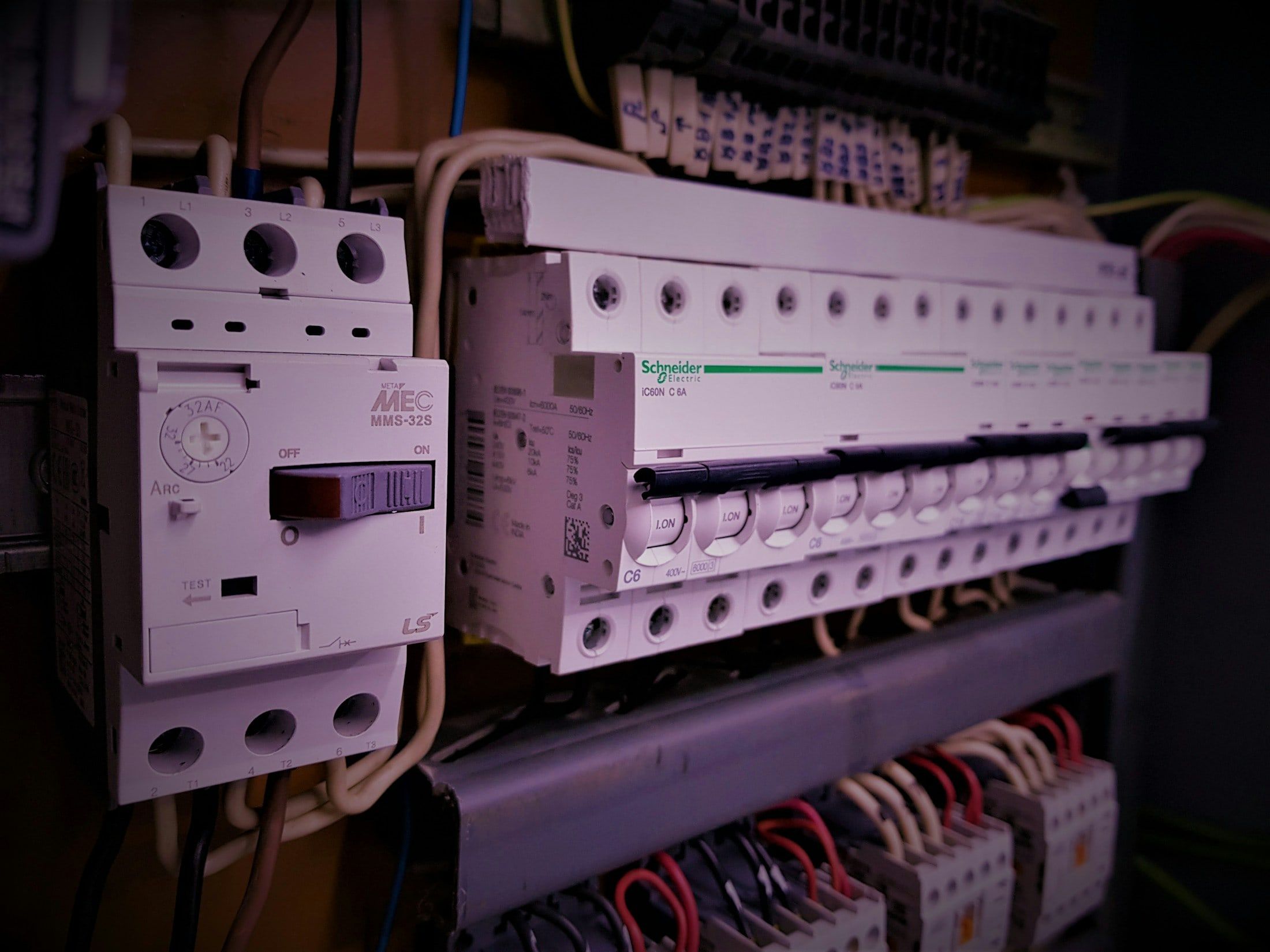
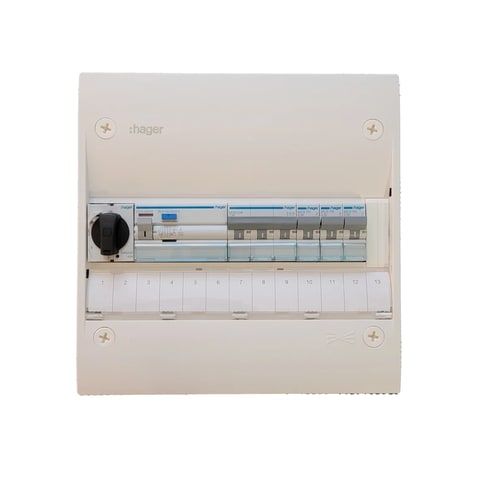

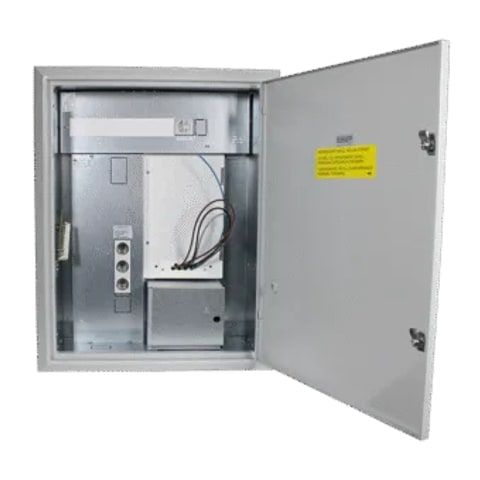
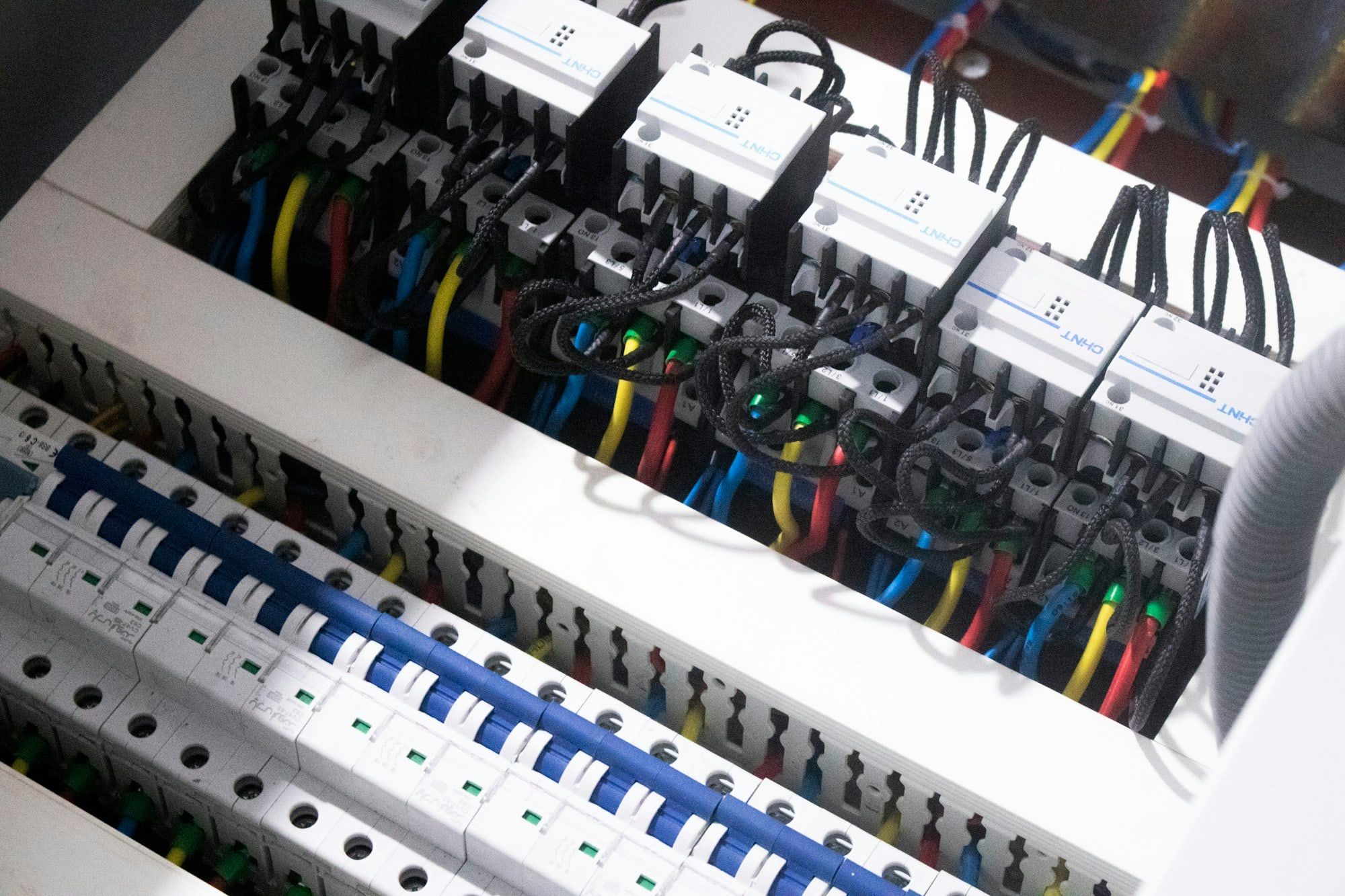


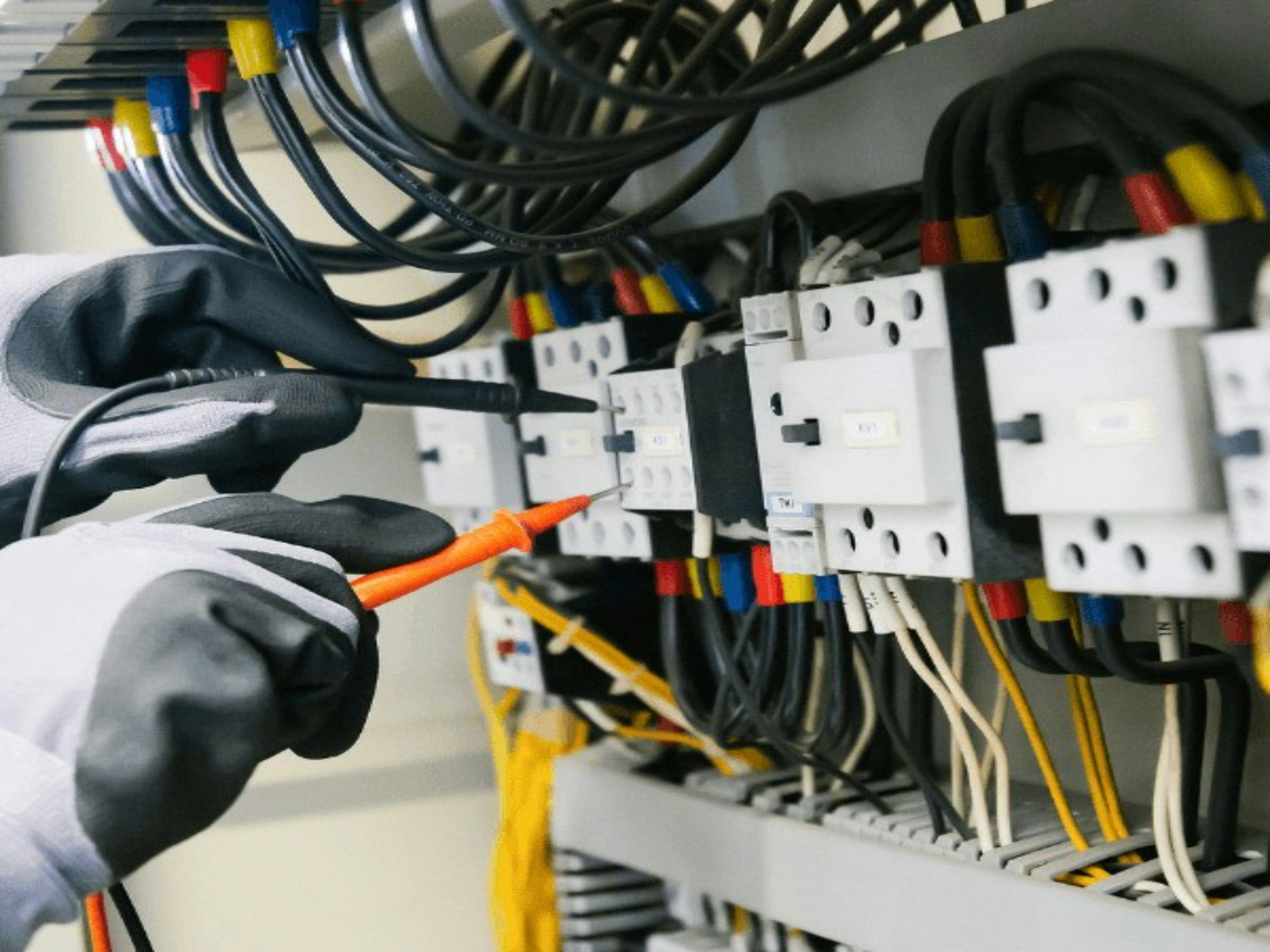
Replacing a consumer unit costs from SEK 5,810 with us, or SEK 4,780 with the Swedish ROT tax deduction for labour on your home (ROT-avdrag). For that you get a Hager Gamma with one row and 13 modules, installed. The largest unit in the price list is a Hager Volta with six rows and 78 modules. It costs SEK 17,615, or SEK 14,971 with ROT. Materials, installation and 25 per cent VAT are included, and a travel charge of SEK 500 is added.
Where between those amounts your replacement ends up, and what may be added, depends on the house. That is what this article goes through.
What you pay for when a consumer unit is replaced
You pay for a new consumer unit and for the work of moving the house’s circuits over to it. A circuit is the sockets and lights that share one fuse. The work goes roughly like this:
- The power is switched off and the old unit is disconnected.
- The new unit is fitted in the same place.
- Each circuit is connected to its own circuit breaker, that is, a fuse that switches off when there is a fault and can be switched on again.
- The unit is labelled and gets a new circuit chart, the list that shows what each fuse supplies.
- The installation is inspected and tested before the power is switched on again.
The last two steps are not optional extras. According to the page on the consumer unit from the Swedish National Electrical Safety Board, Elsäkerhetsverket, there must be an up-to-date circuit chart at the unit. The regulations also require an altered installation to be inspected before it is put into use.
The more circuits the house has, the more wires have to be moved, connected and labelled. That is the main reason why a large unit costs more than a small one. Both the enclosure and the work grow. The house is without power while the replacement is under way.
What makes the replacement more or less expensive
Six things decide most of it. The table shows how each of them appears in our price list.
| Factor | Why it matters | In the price list |
|---|---|---|
| Number of modules | More circuits mean a larger enclosure and more work | SEK 5,810 for 13 modules, up to SEK 17,615 for 78 |
| Enclosure for damp or outdoor use | The unit must withstand its surroundings | SEK 7,222 for one row with 14 modules, rated IP65 |
| Residual current device (RCD) and new circuit breakers | Separate items that are added to the unit | SEK 961 for an RCD, 4-pole 25 A |
| Condition of the wiring | Wires that are too short or damaged have to be put right | Not included, priced separately |
| Moving or rebuilding | A unit in a new position, or new circuits, is a bigger job | Quote |
| Main fuse and meter cabinet | If they are to be changed too, a notification is required to the grid operator (elnätsföretag), the company that owns the local grid, not the company you buy electricity from | SEK 686 for a changed main fuse within 16–25 A, notification included |
You can estimate the number of modules yourself. Count the fuses in the unit you have today and add room for what you are planning, for example an EV charger (wallbox). How to count step by step, and what designations such as 1×13 mean, is explained in the price list for consumer units.
Standard installation and what falls outside it
The fixed prices apply to a standard installation. The unit must be in a normally accessible place, and it must be possible to use the existing cable route. The following is not included:
- fault-finding in the existing electrical installation
- extra work when conditions differ, for example wires that do not reach, damaged insulation or a unit that is to be moved
- the travel charge, which is SEK 500.
An old fuse box with screw-in fuses (proppskåp) can hide things that cannot be seen until it is opened. So ask to be told what extra work will cost before it is carried out. That is a reasonable thing to ask of any electrician.
Ask too what the unit is equipped with, that is, what is fitted in it when it is handed over. An RCD cuts the power when current leaks to earth. It and individual circuit breakers are separate items in our price list. If you compare two prices without knowing what is in the enclosure, you can easily end up comparing an empty unit with a finished one.
ROT only lowers the labour part
The ROT deduction is 30 per cent of the labour cost in 2026. Installing and adding to consumer units is on the list of work that qualifies for the ROT deduction from the Swedish Tax Agency, Skatteverket, both for houses (detached, semi-detached and terraced) and for tenant-owner flats (bostadsrätt).
The unit itself is materials and gives no deduction. For our smallest unit the price is SEK 5,810 without ROT and SEK 4,780 with it. The deduction is therefore SEK 1,030, roughly 18 per cent of the price. A price estimate that promises a 30 per cent lower total price after ROT is not right for a consumer unit replacement.
Three more things are good to know:
- In a tenant-owner flat, the unit must be inside the flat and be your responsibility under the tenant-owner association’s statutes (stadgar).
- In a house that is less than five years old, the work may only restore the electrics to the condition they were in from the start.
- If the unit is replaced to make room for a charger, that part does not qualify for the Swedish tax reduction for green technology (grön teknik), but it may qualify for ROT.
All the conditions are in the article on the ROT deduction for electrical work.
What the law says about the price
A fixed price is the price you and the company have agreed. If you have instead been given an approximate price estimate, the final price may not, under the Swedish Consumer Services Act (konsumenttjänstlagen), be more than 15 per cent higher, unless you have agreed a different limit or the company is entitled to a price supplement. You are also entitled to an itemised bill if you ask for one.
The Act applies to private individuals. We explain the difference between a fixed price, an approximate price estimate and time and materials in the article on what an electrician costs.
How to compare two price estimates
Price guides online give wide ranges for replacing a consumer unit. That is because the word replacement is used for everything from a small unit in a flat to a rebuild with new circuits, an RCD and a new meter cabinet, the cabinet that holds the electricity meter and the main fuses. Ask these questions, and you will be comparing like with like:
- How many modules does the unit have, and what make is it?
- What is fitted in it: RCD, circuit breakers, main switch?
- Is the price before or after ROT, and is VAT included?
- Are the materials included, or does the price cover the labour only?
- What does the travel cost?
- What happens if the wires do not reach or are damaged?
- Is it a fixed price or an approximate price estimate?
You do not have to replace a fuse box that works
There is no requirement to replace an older consumer unit. A fuse box with screw-in fuses is not illegal, and an older installation in good condition may stay. Nor is there any requirement for an RCD in a straight replacement, but Elsäkerhetsverket recommends one because safety is raised for a small extra cost. Whatever is rebuilt or added must follow today’s rules.
Common reasons to replace it anyway are that the unit is full, that the house is getting a charger or other large loads, or that the box is damaged. The reasoning is set out in the article on fuse box or circuit breakers.
If a fuse blows, you do not need an electrician. You may replace a blown screw-in fuse yourself and reset a circuit breaker that has tripped. The unit itself, however, you may not replace yourself. That must be done by an electrical installation company (elinstallationsföretag).
When to get in touch
Send us a photo of the consumer unit with the door open and one of the meter cabinet. Tell us how many circuits the house has and whether you are planning a charger or anything else that needs room. Then we can say which item in the price list applies and whether anything falls outside the standard. We describe how the replacement itself is done on the page about replacing a consumer unit.
Sources
- Elsäkerhetsverket – The consumer unit (in Swedish)
- Elsäkerhetsverket – Do I have to install an RCD when the consumer unit is replaced? (in Swedish)
- Skatteverket – Does the work qualify for the ROT deduction? (in Swedish)
- Skatteverket – How the ROT deduction works (in Swedish)
- The Swedish Consumer Services Act, Konsumenttjänstlag (1985:716) (in Swedish)