

- Our base
- We are based in Malmö
- Places we work in include
- Malmö, Bunkeflostrand, Oxie, Tygelsjö, Skumparp
- Grid operator
- E.ON
The consumer unit is usually in a flat
Malmö has 175,845 homes, and 143,803 of them are in blocks of flats. That is 81.8 per cent. The flats are almost evenly split between 73,954 rented flats and 69,749 tenant-owner flats (bostadsrätt), according to Statistics Sweden (SCB). Who may order a new consumer unit depends on which kind you live in.
Find out three things before you order:
- who is responsible for the unit: you, the tenant-owner association (bostadsrättsförening) or the landlord
- how many circuits the unit has today and how many you need
- whether the unit is inside the flat or in the stairwell
A circuit is the sockets and lights that share one fuse.
In a tenant-owner flat the statutes decide
In a tenant-owner flat you are normally responsible for the electrics from the flat’s consumer unit inwards. The Swedish National Electrical Safety Board, Elsäkerhetsverket, puts it like this: “The association’s responsibility usually ends at the flat’s consumer unit. There you as the tenant-owner take over responsibility for the electrical installation.” The authority adds that the association’s statutes (stadgar) may regulate the matter differently.
The statutes also govern the deduction. In a tenant-owner flat the Swedish ROT tax deduction for labour on your home (ROT-avdrag) is given for work inside the flat’s walls, ceiling and floor that you yourself are responsible for. Installing or adding to a consumer unit is on the list kept by the Swedish Tax Agency, Skatteverket. A unit that sits outside the home gives no deduction. There is more about where the line runs in the guide to electrics in a tenant-owner flat.
In a rented flat the unit is the landlord’s
In a rented flat it is in most cases the property owner who is the holder of the installation (innehavare), the owner or user who is responsible for it. So it is the landlord who orders a replacement, not you as the tenant. You may replace a blown screw-in fuse yourself and reset a circuit breaker that has tripped, that is, switch it back on, but nothing more than that in the consumer unit.
What the building years tell you
| Year the building was built | Flats in blocks of flats |
|---|---|
| Before 1941 | 26,872 |
| 1941–1960 | 34,481 |
| 1961–1980 | 43,751 |
| 1981–2000 | 8,295 |
| 2001 or later | 30,045 |
The requirement for a residual current device (RCD) in new homes came in on 1 January 2000. An RCD cuts the power when current leaks to earth. 113,399 flats, 78.9 per cent, are in buildings from 2000 or earlier. So almost eight in ten flats are in buildings put up before the requirement existed or in the same year it came in.
The year of construction shows which rules applied when the building was new. It does not show what the electrics look like today, because the consumer unit may have been replaced since then. An older unit in good condition may stay. If it is replaced, that counts as maintenance, and then there is no requirement for an RCD. Elsäkerhetsverket still recommends fitting one when the unit is replaced, because it raises safety for a small extra cost.
Price and size
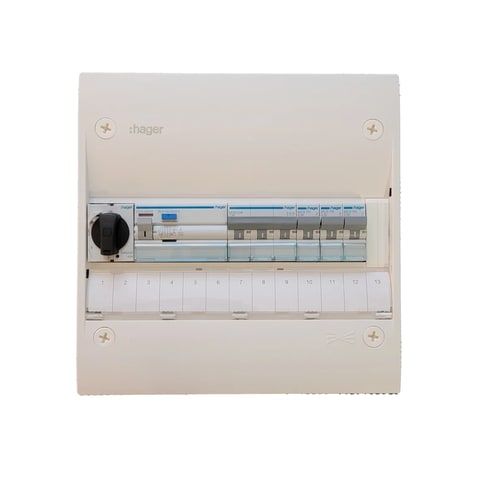
A Hager Gamma with one row and 13 modules costs SEK 5,810, or SEK 4,780 with ROT. The same unit with 18 modules costs SEK 6,578, and two rows with 13 modules each SEK 8,627. The price includes materials, installation and VAT, and it applies to a standard installation. A four-pole RCD has its own line in the price list: SEK 961, or SEK 673 with ROT. All sizes are on the page with fixed prices for consumer units.
How many modules you need depends on the number of circuits, not on whether the home is a flat or a detached house.
Detached and terraced houses
28,201 of Malmö’s homes are in houses (detached, semi-detached and terraced), among other places in Bunkeflostrand, Oxie and Tygelsjö. The largest number were built in 1961–1970. In a house of your own, you are yourself the holder of the whole electrical installation and decide about the consumer unit.
If the main fuse is to be changed at the same time, we file a notification with E.ON, which owns the grid in Malmö. The main fuse limits how much electricity can be used at once. A travel charge of SEK 500 is added. LVJ-EL is registered with Elsäkerhetsverket for electrical installation work in dwellings. How a replacement is done step by step is described on the page about replacing a consumer unit.